

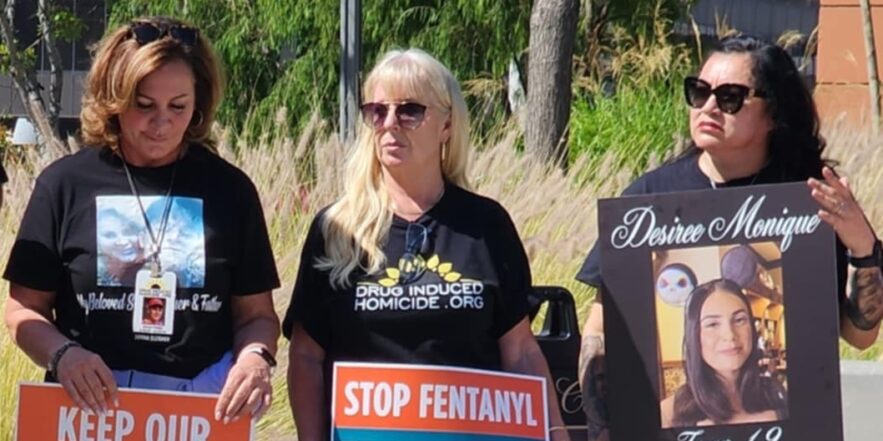
For Claudia Contreras, the connection between social work and addiction recovery is personal. A student in the online Bachelor of Social Work (BSW) program at Pacific Oaks College, she’s combined her education with an internship in residential treatment as well as work supporting previously incarcerated women, and fentanyl education.
Her motivation grew from a devastating loss. After her 19-year-old daughter died of fentanyl poisoning, Contreras became determined to help young people facing mental health crises and to give families the information and support to prevent the death of a loved one.
Returning to Social Work Education
Contreras first enrolled in community college in 2004, where academic struggles and a lack of counseling support led her to stop short of earning her associate degree. However, she explains, “I had already earned my certificate in drug studies, and with that I was able to become a certified drug and alcohol counselor.”
Later, an incident at work caused Contreras to leave the field and access support from disability insurance. During that period of uncertain employment, her daughter encouraged her to return to counseling, reminding her of the difference she could make.
“She would say, ‘Mom, you should go back. You’re good at what you do,’” Contreras recalls. “After my daughter passed away, I figured out what my purpose was,” she says. Contreras became determined to work with at-risk youth experiencing suicide ideation and acute mental health crises. “I know that my daughter was experiencing those things, and she didn’t let anyone know.”
Contreras’ first step on her path was to complete her education. Being just a few credits shy of graduation, she chose to complete her associate degree in sociology. This time, she was able to overcome her struggles with math, and that success helped inspire her to pursue a bachelor’s degree. “I thought if I could pass statistics, I could do anything,” she recalls.
Finding Support While Studying Online
After completing her associate degree, Contreras worked as a monitor for residents at a drug and alcohol recovery agency. With a drive to make a greater impact, she learned about Pacific Oaks College from a colleague.
Her employer initially offered tuition support, though a later job change ended that benefit. Still, she remained committed to completing her BSW.
Pacific Oaks’ online BSW provides undergraduates with hands-on experience working in the field and supports working adults who are returning to complete their education. The program is accredited by the Council on Social Work Education (CSWE) and prepares students for entry-level social work practice.
Contreras experienced such support recently when another of life’s challenges presented itself. “During my field seminar, my mother had triple bypass surgery,” she says, “but I pushed through. I was there in the hospital waiting room doing my coursework on my computer.”
Contreras credits her fieldwork supervisor, Sean Taitt, MSW, with helping her through that experience. “He’s been very patient with me, because sometimes it’s hard for me to grasp things when I’m overwhelmed with life.” Contreras says her Pacific Oaks classmates also help her maintain connection even though her courses are online. She keeps in touch with her fellow learners via a group chat outside of class, and she has utilized the tutoring program available from the Student Success Center.
Fieldwork in Addiction Recovery
Social workers can support addiction recovery by helping people find services, support groups, and community resources. Responsibilities depend on the role and professional credentials, as outlined by the U.S. Bureau of Labor Statistics.
Contreras is currently completing her internship with the Los Angeles Centers for Alcohol and Drug Abuse (L.A. CADA) at Allen House, a residential treatment program with longtime ties to Pacific Oaks College. She currently works for L.A. CADA’s Female Community Reentry Program (FCRP), which helps incarcerated women transition back into the community. Contreras manages four groups for the FCRP, with a caseload of 16 women.
These experiences connect two parts of her professional interests: helping people affected by substance use and supporting people navigating major life transitions. They also show how one student’s social work education can intersect with community-based services before graduation.
Fentanyl Education and Overdose Prevention
Additionally, Contreras founded a nonprofit called Beauty from Ashes, from Loss to Purpose, in honor of her daughter, which focuses on fentanyl education and overdose prevention. As part of her work, she distributes naloxone, commonly known by its brand name Narcan, an emergency medication that can rapidly reverse the effects of an opioid overdose according to the Centers for Disease Control and Prevention. “I educate families and communities on how to use it, what it’s for, and how to recognize signs of overdose,” Contreras says.
For Contreras, community education is another way to reach people who may not know where to turn for help. It extends her commitment beyond her coursework and workplace, keeping her daughter’s memory connected to her service.
Continuing Toward a Social Work Career
Contreras is on track to complete her degree in December 2026 and will receive her diploma at commencement in the spring of 2027. She plans to continue her education to earn her master’s degree.
“I feel like if I continue on this path, that bigger opportunities are going to open up,” she says. “I know in my spirit that doors are going to open for me if I continue to do what I’m doing.” That work includes giving young people who suffer from addiction the help her daughter didn’t receive. “She never got the chance to ask for help, and I never got the chance to say, ‘Let me take you somewhere to get help.’”
Her experience brings together the reasons she returned to school: expanding her professional opportunities, supporting people affected by addiction, and helping young people access support. Through her work, Contreras hopes to honor her daughter’s memory and, in doing so, to save lives and to make families whole.
Frequently Asked Questions About Social Work Education
Can an online BSW include hands-on experience?
Yes. Pacific Oaks’ online BSW includes in-person fieldwork in community settings alongside online coursework. Contreras’ internship at Allen House is one example of a student’s field experience.
Does a BSW qualify someone for clinical practice?
A BSW prepares students for entry-level, nonclinical social work roles. Clinical social workers need an MSW, supervised clinical experience, and state licensure, according to the U.S. Bureau of Labor Statistics.
How do social workers support addiction recovery?
Social workers help people affected by substance use access services, find support groups, and navigate challenges in their lives. Their responsibilities depend on their position, education, and credentials; clinical roles require additional qualifications beyond a bachelor’s degree.
What skills can BSW students apply in addiction recovery settings?
Pacific Oaks’ BSW curriculum explores case management, care coordination, policy change, and program implementation—areas relevant to connecting people with services and strengthening community support. In Claudia Contreras’ story, residential-treatment fieldwork and community-reentry employment illustrate two settings where her education intersects with helping others.
Can working adults pursue an online BSW?
Yes., Pacific Oaks offers its BSW coursework online to support flexibility for working professionals, while fieldwork takes place in person. Prospective students should discuss placement schedules and coursework expectations with the program to understand how these commitments could fit around employment.
Is Pacific Oaks’ online BSW program accredited?
Yes. Pacific Oaks College’s online Bachelor of Social Work program is accredited by the Council on Social Work Education’s Board of Accreditation, which evaluates social work programs against established quality standards.
Can students pursue a master’s in social work after earning a BSW?
Yes., BSW graduates can pursue an MSW, and eligible applicants may qualify for an advanced-standing program. Pacific Oaks offers an online advanced-standing MSW pathway with specific admissions requirements; completing a BSW does not guarantee admission.
Cover photo: Claudia Contreras (right) and other mothers bring fentanyl poisoning awareness to the community.
For more information on Social Work and other programs a Pacific Oaks College, please fill out the form below.
