

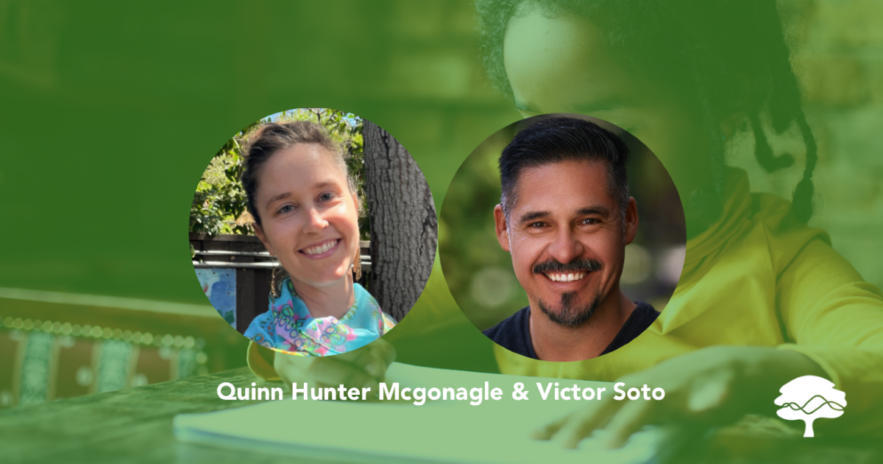
For 70 years, the Pacific Oaks College departments of Education and Human Development have been partnering with Pacific Oaks Children’s School on advancing new and better approaches to early childhood education. Currently, as part of an internship program in the Social Work department, two students are working in the children’s school, gaining valuable on-site experience while supporting the students, children, and faculty alike.
“Because a lot of Social Work placements were more at clinical sites that were mostly working with adults, the department wanted to pilot this new collaborative program with real-life experience at the ground level with young children and families,” says Quinn Hunter McGonagle, M.S., associate director of Pacific Oaks Children’s School. “So, this was an obvious match, and it’s in line with our strategic action planning in terms of building the bridge between Pacific Oaks College and the children’s school.”
For social work students, the internship offers experience that can be difficult to find in more traditional placements. While many placements are based in clinical settings or agencies serving adults, the children’s school gives interns opportunities to work directly with young children and families. They observe classrooms, collaborate with educators, and learn how social work can support children at an early stage of development.
Now entering its second year, the program began at a time when the Pacific Oaks community was still reeling from the Eaton Fire that ravaged the area a few months earlier. Victor Soto, M.A., executive director of the children’s school, says that when families are struggling, it’s natural for them to turn to educators. That makes this internship a strong opportunity to connect students training in social work with those at the children’s school who can benefit from their expertise.
“I appreciate the support from President McGrath and especially the Social Work faculty,” Soto says. “We came to them to say we need more support for our children, for our families, for our teachers. That’s where this rose from, especially after the wildfires.”
The interns are introduced to the children’s school community at the annual Back to School Night, so the parents know who they are and that they will be available for consultation. From that point on the interns have hands-on interactions throughout their 16 hours a week, including observing classrooms with children who may have special developmental needs, meeting with teachers, and talking with the parents.
Additionally, last year the first two social work interns, Philip Jessen and April Reynoso, created a framework for the program, with Reynoso putting together a Social Work Interns Toolkit, which contains the necessary forms the interns will use, a children’s reading list for parents, and a scope of practice outlining for staff and parents what the interns are permitted to do. Jessen contributed a resource guide for parents, providing tools including an ages and stage questionnaire (ASQ) that teachers and parents fill out and consult on to determine if there are any possible concerns with a child’s development.
In addition, the interns are creating programs for the community. Reynoso and a teacher from the children’s school put together a parent education workshop for the families on the topic of body awareness and autonomy from a developmental perspective with a focus on how to support children and parents.
McGonagle says she realized the program was succeeding when more and more parents were asking, “Are the social work interns here today?” She saw that the interns offered a fresh set of eyes to parents who felt speaking with someone could offer an outside perspective. “Witnessing that was a delight,” she says.
For Soto, an important part of this collaboration is making resources available to members of a community who are still processing an ongoing trauma of lost lives, lost homes, and a lost sense of safety. “Putting parents in a vulnerable position to open up to talk about their struggles, that’s not easy,” he says. “When I think about the bigger picture of the vision of the school, the college, and the children’s school, that is what we’ve been working towards.”
